Montessori Education Benefits for Children: A Complete Guide
- Amazing Star
- May 16
- 5 min read

They touch, test, explore, and question everything around them-not because someone told them to, but because learning is instinct. The real question is not whether your child can learn. It is whether their education works with that instinct or against it.
Montessori education is built on one powerful premise: when children are trusted, given the right environment, and allowed to lead their own learning, they do not just keep up—they thrive. They develop focus, independence, creativity, and a genuine love of learning that no exam score can measure.
This guide breaks down exactly what Montessori education is, why it works, and what it means for your child's future.
What Is the Montessori Method of Teaching?
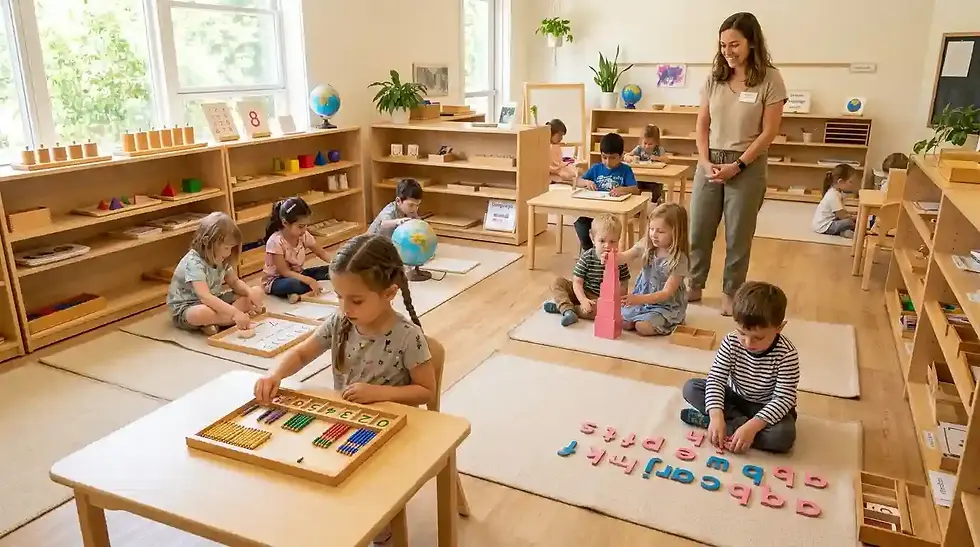
Instead of rows of desks and a teacher lecturing at the front, Montessori classrooms are active, self-directed spaces. Children choose their own activities from carefully designed materials that teach through touch, movement, and real discovery. Teachers act as guides, observing, supporting, and stepping in only when needed.
Key features include:
Teachers as guides, not lecturers
A prepared environment designed for hands-on exploration
Freedom within a clear structure
Mixed-age classrooms where older children naturally mentor younger ones
Long, uninterrupted work periods that build real concentration
The result is a learning community, not a room where information is delivered, but a space where children actively build their own understanding.
Key Benefits of Montessori Education for Children
1. Independence That Lasts a Lifetime
Children make real decisions every day — choosing activities, managing their time, and solving problems on their own. This builds confidence and self-reliance from an early age. Montessori children not only follow instructions well; they also learn to think independently.
2. Deep Critical Thinking Skills
Hands-on learning helps children truly understand concepts instead of simply memorising answers. They experiment, make mistakes, and learn through correction. Research shows Montessori students often develop stronger focus, planning, and problem-solving skills than those in traditional classrooms.
3. A Genuine Love of Learning
Without grades or constant pressure, children learn because they are naturally curious. This creates a positive relationship with education and reduces anxiety. Children who enjoy learning are more likely to stay motivated throughout life.
4. Emotional and Social Intelligence
Mixed-age classrooms teach children how to communicate, empathise, and respect others in practical ways. They learn to resolve conflicts calmly, collaborate with others, and develop patience. These life skills play an important role in both personal and professional success.
5. Creativity and Problem-Solving
Open-ended materials encourage children to think freely, experiment confidently, and explore different ideas. There is rarely one fixed answer, which supports creativity and independent thinking. This environment helps children become more adaptable and innovative.
Montessori in Early Childhood: Why It Matters Most

Early childhood is one of the most important stages of brain development. Montessori education is designed to support children during this period by nurturing both academic and personal growth.
Language Development: Children develop vocabulary and literacy through conversation, storytelling, and daily interaction rather than worksheets alone. Learning a language naturally helps strengthen communication skills.
Mathematical Thinking: Materials such as beads, rods, and blocks allow children to physically explore numbers before working with abstract concepts. This creates a stronger understanding of mathematics later on.
Focus and Concentration: Long, uninterrupted work periods help children stay engaged with tasks for deeper learning. Over time, this improves patience, focus, and attention span.
Motor Skills: Activities such as pouring, cutting, threading, and building improve fine motor coordination and encourage independence in everyday tasks.
Montessori Preschool Skills at a Glance
Area of Development | Montessori Approach | Key Outcome |
Language | Storytelling, conversation, vocabulary exposure | Strong communication skills |
Mathematics | Hands-on materials — beads, rods, blocks | Concrete understanding of numbers |
Focus | Long, uninterrupted work cycles | Deep concentration and patience |
Motor Skills | Practical life activities | Better coordination and independence |
Preschool in Singapore and the Montessori Approach
In many modern education systems, including options like preschool in Singapore, there is a growing focus on early childhood development that aligns closely with Montessori principles. Parents often explore such environments because they emphasise structured learning combined with play-based exploration, independence, and social development.
This reflects a broader global shift toward child-centred education, where learning is not just about memorisation, but about building real-life skills, curiosity, and confidence from an early age.
Why Montessori Matters More Than Ever

The world no longer rewards memorisation. It rewards creativity, adaptability, critical thinking, and emotional intelligence — exactly what Montessori builds through daily practice, not theory.
Children also develop values that shape who they become:
Responsibility — caring for their environment and the people in it
Self-discipline — learning through natural consequences, not punishment
Respect — for others, for materials, and for themselves
These are not academic achievements. They are the foundation of character.
Montessori for Toddlers (Ages 1–3)
The toddler years are a remarkable period of rapid absorption. Children at this stage learn from everything around them at a speed they will never match again. Montessori supports this natural window through structured freedom and sensory-rich experiences.
Key benefits at this stage include:
Sensory exploration through touch, sound, and movement
Practical life skills such as dressing, cleaning, and pouring
Natural language development through constant, meaningful interaction
Freedom of movement to support physical growth and coordination
Starting Montessori early gives children a head start that compounds over time.
Long-Term Impact: What the Research Shows

Children who experience Montessori education consistently show stronger long-term outcomes across multiple areas:
Better academic and social performance
Improved creativity and self-regulation
Stronger emotional development and resilience
Over time, Montessori students tend to grow into confident, independent adults who adapt well, lead naturally, and continue learning long after their school years are over.
Is Montessori Right for Every Child?
Most children respond very well to the Montessori approach — but the quality of the school makes an enormous difference in outcomes. Not every school that uses the Montessori name delivers a genuine Montessori experience.
When evaluating a school, look for:
AMI or AMS certified teachers
Authentic Montessori materials and classroom setup
Trained educators with real Montessori experience
Consistent, uninterrupted work cycles
It is also worth noting that children with highly structured learning preferences or those transitioning from traditional schooling later may need an adjustment period. That transition is manageable — but worth planning for.
Conclusion
Montessori education works because it starts with the child, not the curriculum. It builds independence, curiosity, emotional intelligence, and real academic skills — not through pressure, but through trust and the right environment. Children who learn this way do not just perform well in school. They grow into capable, confident, self-directed people ready for real life.
When delivered in a well-run, properly certified environment, Montessori education is one of the most powerful investments you can make in your child's future.
Frequently Asked Questions
What are the main benefits of Montessori education?
Montessori develops independence, critical thinking, creativity, and emotional intelligence alongside strong academic foundations — all through self-directed, hands-on learning.
At what age should a child start Montessori?
Most programs begin between 18 months and 3 years. Starting early takes advantage of the brain's most rapid developmental window, but children benefit at any age.
Is Montessori better than traditional education?
Research consistently shows Montessori students outperform peers in independence, creativity, and social development. Academic outcomes are strong too — but the bigger difference is in how children approach problems and people throughout life.
Is Montessori expensive?
Private Montessori schools often cost more due to certified teachers and specialised materials. However, public and lower-cost Montessori options exist in many areas and are worth exploring before ruling it out.
What are the disadvantages of Montessori?
Children transitioning to traditional schooling later may need an adjustment period. Quality also varies significantly between schools — a poorly implemented Montessori program delivers far weaker results than an authentic one.
How does Montessori support child development?
It supports cognitive, emotional, social, and physical growth simultaneously through self-paced, hands-on learning in a structured but flexible environment.
What skills do children learn in Montessori?
Independence, deep focus, problem-solving, empathy, leadership, and creativity — skills that support lifelong learning, strong relationships, and personal growth.


Comments