Montessori Preschools in Singapore: A Complete Guide
- Amazing Star
- May 16
- 5 min read

Choosing the right preschool is one of the most important decisions in a child’s early years. In Singapore’s fast-paced environment, many parents now prefer a Montessori preschool in Singapore that supports both academic growth and overall development.
Montessori education stands out because children learn through exploration, creativity, and hands-on experiences instead of rigid instruction. This approach helps build independence, focus, confidence, and problem-solving skills at a natural pace.
In a Montessori preschool, learning is guided but never forced. Teachers observe, support, and gently guide children while they explore activities that strengthen emotional, social, physical, and intellectual development.
Montessori vs. Traditional Preschool in Singapore

Before choosing a preschool, it is important to understand how Montessori education differs from traditional early childhood learning systems. Both aim to support children’s development, but their teaching methods, structure, and learning philosophy are very different.
Feature | Montessori Preschool | Traditional Preschool |
Teaching Style | Child-led and individualised | Teacher-led and structured |
Learning Pace | Self-paced development | Fixed curriculum pace |
Classroom Structure | Multi-age classrooms | Single-age classrooms |
Assessment | Observation and portfolios | Tests and worksheets |
Learning Method | Hands-on exploration | Repetition and instruction |
Focus | Independence and holistic growth | Academic preparation |
This comparison helps parents see clearly why Montessori education is often preferred by families
seeking a more flexible, child-centred, and development-focused learning environment.
Why Montessori Preschools Are Popular in Singapore
Montessori education has grown significantly in popularity among Singaporean families over the years. Many parents today want more than academic preparation alone—they want their children to develop confidence, emotional intelligence, creativity, and practical life skills from an early age.
Here are some of the key reasons why Montessori preschools continue to attract parents across
Singapore.
Holistic Child Development
Montessori learning focuses on developing the whole child rather than concentrating only on academic achievement. Children strengthen literacy and numeracy skills while also learning communication, responsibility, emotional regulation, and social interaction.
Child-Led Learning Environment
Every child learns differently. Montessori classrooms allow children to progress at their own pace through hands-on activities and guided exploration. This encourages stronger concentration, deeper understanding, and greater confidence in learning.
Bilingual Learning Support
Many Montessori childcare centres in Singapore naturally incorporate English and Mandarin into everyday classroom experiences. Through storytelling, songs, conversations, and interactive activities, children become more comfortable communicating in both languages.
Hands-On Learning Experiences
Instead of memorising information through repetition alone, children learn by touching, moving, experimenting, and exploring. This creates a more engaging and meaningful learning experience while nurturing natural curiosity.
Benefits of Montessori Education for Children

Montessori education supports long-term child development by helping children build valuable life skills alongside academic knowledge.
Independence and Confidence
Children are encouraged to manage everyday tasks independently, from organising learning materials to cleaning up after activities. These responsibilities help strengthen self-confidence and decision-making skills.
Love for Learning
Montessori classrooms encourage children to explore their interests through meaningful activities. This helps children enjoy learning naturally rather than depending on pressure or rewards.
Social and Emotional Growth
Mixed-age classrooms help children develop empathy, patience, teamwork, communication, and leadership abilities through collaborative learning experiences.
Practical Life Skills
Activities such as pouring, sorting, dressing, preparing snacks, and cleaning help children improve coordination, concentration, responsibility, and self-reliance.
Strong Academic Foundations
Language, mathematics, science, and early literacy concepts are introduced through hands-on materials that make learning easier to understand and more enjoyable for young children.
Montessori Teaching Principles and Learning Approach
Montessori classrooms are carefully designed to create calm, organised, and purposeful learning environments where children feel comfortable exploring independently.
Unlike in traditional classrooms, where teachers lead most activities, Montessori educators gently guide children while encouraging self-directed learning. Children are free to choose activities that match their interests and developmental stage, helping them become more focused and motivated learners.
Each classroom activity is intentionally designed to support:
concentration
creativity
coordination
independence
communication
problem-solving
Whether children are tracing letters, arranging counting materials, watering plants, or working with sensorial tools, every task contributes to both personal and academic development.
What Children Learn in a Montessori Curriculum
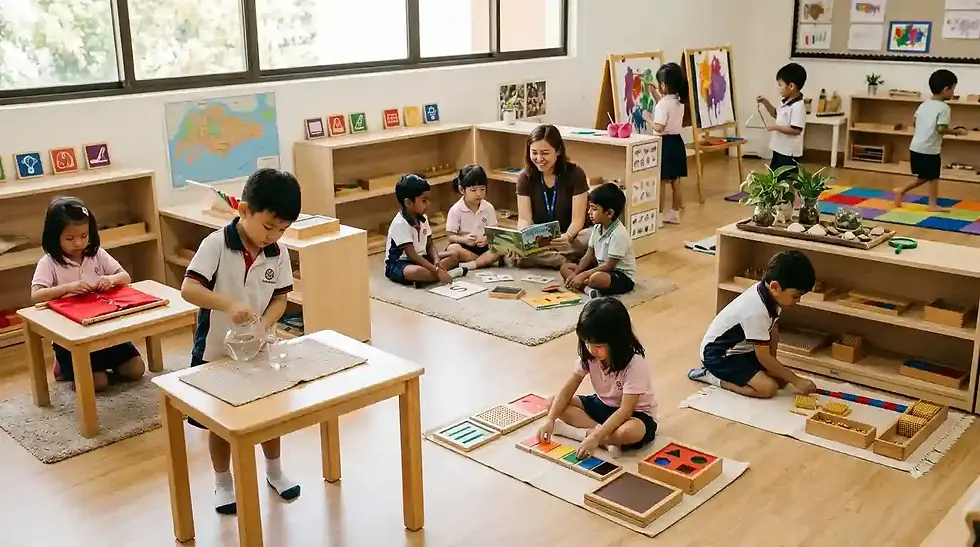
The Montessori curriculum is structured around several key developmental areas that support a child's overall development.
Practical Life Activities
Children learn everyday skills such as cleaning, pouring, buttoning clothes, food preparation, and organising materials. These activities build independence, discipline, and motor coordination.
Sensorial Learning
Sensorial materials help children understand shapes, textures, colours, sounds, sizes, and patterns through hands-on exploration and observation.
Language Development
Children develop vocabulary, phonics awareness, reading confidence, storytelling abilities, and early writing skills through interactive learning experiences.
Mathematics Learning
Montessori mathematics uses concrete materials such as counting beads and number rods to help children understand mathematical concepts visually and physically before moving to abstract learning.
Cultural and Science Exploration
Children are introduced to geography, biology, nature, music, art, and cultural studies to help them better understand the world around them.
Creative and Physical Development
Art, music, movement activities, outdoor exploration, and imaginative play are also included to support creativity and physical coordination.
Montessori Learning Materials and Toys
Montessori learning materials are designed to be simple, purposeful, and development-focused. Unlike overly stimulating electronic toys, Montessori materials encourage concentration, creativity, independence, and self-correction.
Popular Montessori materials include:
counting beads
sandpaper letters
wooden puzzles
shape sorters
practical life trays
number rods
sensorial blocks
Each material is carefully designed to teach a specific concept while encouraging children to learn through repetition and discovery.
Many parents also introduce Montessori-inspired toys and activities at home to reinforce learning outside the classroom.
Choosing the Right Montessori Preschool in Singapore

Not all schools that use the term “Montessori” follow authentic Montessori teaching methods. Parents should carefully evaluate preschool environments before enrolling their child.
Qualified Montessori Teachers
Look for teachers with recognised Montessori certifications and experience in child-centred education.
Authentic Montessori Environment
A quality classroom should include organised learning spaces, hands-on materials, and opportunities for self-directed learning.
Balanced Bilingual Programme
Many parents in Singapore prefer Montessori schools that support the natural development of both English and Mandarin through daily activities.
Safe and Nurturing Atmosphere
Children learn best when they feel secure, respected, and emotionally supported in the classroom environment.
Strong Parent Communication
Regular updates, progress discussions, and open communication between teachers and parents are important for supporting a child’s development.
Visiting the preschool in person is often the best way to assess whether the environment aligns with your child’s personality and learning needs.
Montessori Preschool Fees in Singapore
Montessori preschool fees in Singapore can vary depending on factors such as:
location
programme duration
teacher qualifications
facilities
curriculum structure
class size
Below is a general estimate of Montessori preschool fees in Singapore.
Programme Type | Estimated Monthly Fees |
Half-Day Programme | SGD 1,200 – SGD 1,800 |
Full-Day Programme | SGD 2,000 – SGD 2,800+ |
Premium International Preschool | SGD 3,000 |
Additional costs may include:
registration fees
uniforms
insurance
enrichment programmes
learning materials
Some ECDA-licensed childcare centres may also provide government subsidies for eligible families.
Conclusion
Montessori education builds a strong foundation that goes beyond academics. Through hands-on learning, practical life activities, bilingual exposure, and child-led exploration, children develop independence, creativity, confidence, and a genuine love for learning. For many families, choosing the right preschool in Singapore offers a balanced and nurturing environment where children can grow emotionally, socially, physically, and intellectually during their early years. By understanding Montessori principles and carefully evaluating preschool environments, parents can make confident decisions that support both present development and future success.
Frequently Asked Questions
Is Montessori suitable for all children?
Most children adapt well to Montessori learning environments, especially those who enjoy hands-on exploration, movement, creativity, and independent learning experiences.
At what age can children join a Montessori preschool?
Many Montessori preschools in Singapore accept children from around 18 months through kindergarten age.
Do Montessori children transition well into Primary 1?
Yes. Montessori children often develop strong concentration, independence, communication skills, and confidence, which helps them adjust smoothly to formal schooling.
Are Montessori preschools expensive in Singapore?
Fees vary depending on programme type, location, facilities, and curriculum quality. Montessori programmes are generally positioned within the mid-to-premium preschool category.
Do Montessori schools offer bilingual education?
Many Montessori preschools in Singapore include bilingual learning experiences that support both English and Mandarin language development naturally within daily activities.


Comments